

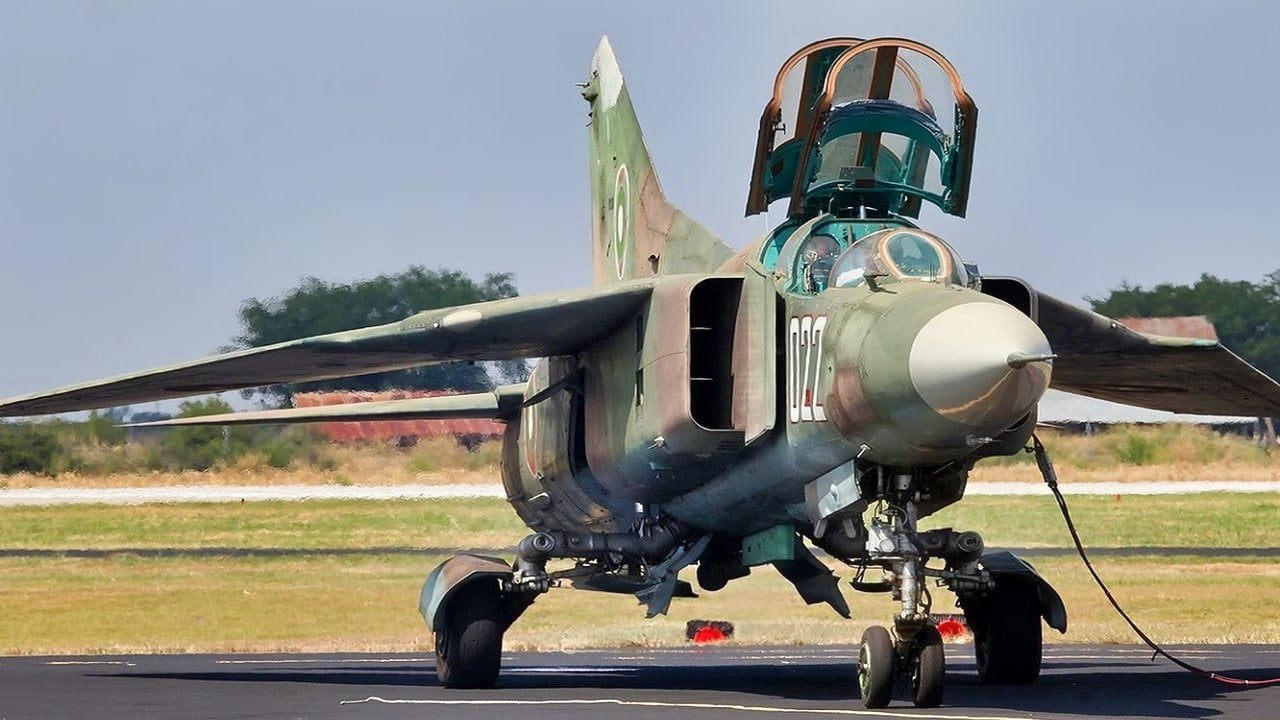
The MiG-23 occupies a special place in the history of Soviet military aviation. It is not just a successor to the MiG-21. It marks a change in the way the USSR designed its Soviet fighter aircraft at the height of the Cold War. The program was launched between 1964 and 1966, at a time when the MiG-21 remained fast and simple, but showed clear limitations in terms of range, payload capacity, all-weather interception, and operation from rudimentary runways. The MiG-23 made its first flight in 1967 and entered operational service in the early 1970s, between 1970 and 1971 according to sources.
The response from the Mikoyan-Gurevich design bureau was technical rather than doctrinal. The MiG-23 was equipped with a much more powerful engine than the MiG-21, a more sophisticated radar, a longer engagement range, and, above all, a variable-geometry wing. This choice was not insignificant. The USSR was seeking a compromise between two requirements that pulled the aircraft in opposite directions: good low-speed performance for takeoff, landing, and use on less prepared terrain, and high speed for interception. The variable wing allows this compromise to be adjusted according to the flight phase. This is the most recognizable feature of the Flogger, the NATO name for the MiG-23/27 family.
The MiG-23 must also be placed in the Soviet hierarchy. It is not a pure light fighter like the MiG-21, nor is it a heavy interceptor comparable to the MiG-25. It sits in the middle: more complex, more expensive, more versatile, but still compatible with mass production. This explains the volume produced: more than 5,000 units of all versions combined, according to the major American museums that preserve the aircraft. This figure is considerable for a variable-geometry fighter and clearly shows the importance of this type of aircraft in the Soviet forces, among the Warsaw Pact allies, and for export.
From the outset, the MiG-23 was not simply a transitional aircraft. It served to bring Soviet fighter aviation into a more modern segment: more autonomous interception, greater range, more flexible use, and the integration of avionics that paved the way for subsequent generations. However, its journey would be less linear than expected. The concept was sound on paper, but the aircraft required a level of development, maintenance, and training that not all user forces were able to master to the same degree. This is one of the reasons for its mixed reputation in military historiography.
The airframe and weapons system: a fast, responsive, and demanding formula
Technically, the Mikoyan-Gurevich MiG-23 is based on a single-engine airframe with side air intakes, combined with a variable-geometry wing that can be adjusted in flight. The published positions for the MiG-23 are 16°, 45° and 72°. In the open position, the wing facilitates takeoff, landing and flight at lower speeds. In the intermediate position, it provides a compromise for combat or transit. In the fully closed position, it reduces drag for supersonic flight. This architecture allows the MiG-23 to maintain high speed while retaining adequate performance on runways shorter than those required by a fixed wing optimized solely for high Mach speeds.